Why Enterprise AI Keeps Failing (Hint: It's Not the Technology)
Worldwide AI spending is forecast to reach $2.52 trillion in 2026. Over 80% of those projects fail. The technology isn't the problem. The approach is.


Free AI Readiness Survey
How ready is your company for AI? Take our 3-minute assessment and get a personalized readiness report.
Worldwide AI spending hit $1.76 trillion in 2025 and is forecast to reach $2.52 trillion in 2026, a 44% increase year-over-year, according to Gartner. The AI consulting market alone reached $11 billion in 2025 (Future Market Insights), with Accenture committing $3 billion to its AI practice and planning to scale to 80,000 AI professionals by 2026. Companies are investing more than ever in AI transformation. And over 80% of those projects fail to reach meaningful production deployment, roughly twice the failure rate of non-AI technology projects, according to RAND. A more recent MIT study from August 2025 puts the number even higher: 95% of generative AI pilots fail to achieve rapid value.
Meanwhile, your employees are already using AI. According to IBM's 2025 study of 3,000 workers, 78% use unauthorized AI tools at work. Only 22% stick to employer-provided ones. They're not waiting for the strategy deck. They're just doing it.
The technology isn't the problem. The approach is.
The Gap Between AI Demos and Reality
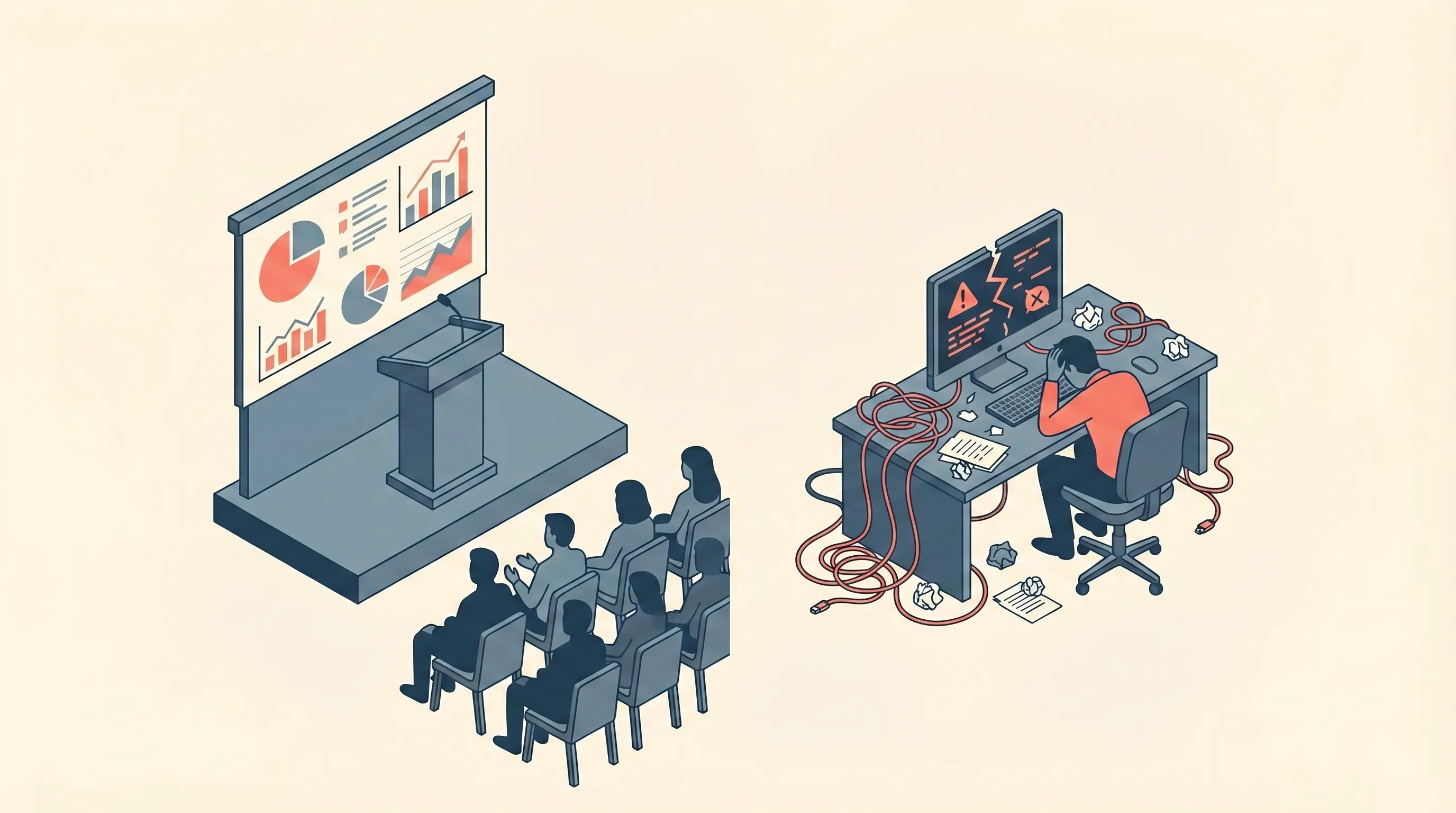
There's a gap in the AI space that doesn't get enough attention. On one side, you have the polished demos. The conference talks. The YouTube videos showing AI doing remarkable things in controlled environments. The consulting decks projecting 5x ROI within 18 months.
On the other side, you have the actual practitioners. The engineers who inherited the codebase. The team leads who sat through six rounds of consultant meetings. The developers who watched their company spend millions on a problem they could have solved in a week.
Their stories sound different.
In one widely shared account, a team lead described their company's "AI Enablement" consultants. The entire process consisted of feeding the team's job descriptions into an AI model, sharing the output, asking for feedback, and repeating. Six rounds in, the AI was still spitting out meaningless buzzwords. Meanwhile, the actual team already knew exactly where AI could help. Nobody asked them.
The most upvoted response put it simply: "It seems like you could replace the consultants with AI and save some money."
And it's not just the consultants who are struggling. In a separate discussion among consultants themselves, a practitioner described how directors and engagement leads at their own firm had "turned off their brain and gone full ChatGPT," using AI to generate storyboards, root cause analyses, and solutions that amounted to "generic talking points and no useful insights whatsoever." The post resonated widely, not because it was controversial, but because everyone recognized it. Even the people selling AI transformation are misusing the technology themselves.
The Staffing Problem
As of early 2026, generative AI in the enterprise is barely two years old. Genuine deep expertise is rare. And the way big consulting firms staff their AI engagements makes the problem worse.
The National CIO Review reported that "many firms were slow to recruit true AI talent and instead leaned on generalized consultants who lacked meaningful experience with commercial AI." In some cases, "consultants were perceived as learning on the job, at the client's expense, eroding confidence and creating a sense of overbilling for underwhelming results." MIT's 2025 analysis of enterprise AI failure rates pointed to the same root cause: not bad models, but a "learning gap" between the people running the projects and the technology itself.
The practitioner-level view is even blunter. In a widely discussed industry thread about the structural decline of consulting, one commenter summarized it: "Selling a project based on past performance and then sending in a team of green newbies who are really only experienced as Excel monkeys good at building pretty slides has always been a giant joke." In a separate account, a consultant described their firm hiring an "AI Thought Leader" with no AI education, no relevant work experience, and no active projects, who spent work hours posting AI memes on LinkedIn. The most upvoted reply: "There are partners all over the world hawking AI, and I bet less than 5% even know how it works."
This isn't about individual consultants being bad at their jobs. It's a structural problem. AI projects need hands-on technical depth, not generalists running a playbook.
Too Many Tools, No Central Strategy

When I look at how most enterprises approach AI adoption, the biggest mistake isn't the technology they choose. It's that they're being convinced by a lot of different people to use a lot of different tools, without any central direction.
Everyone's using something different. Marketing has one tool, sales has another, engineering has three. Nobody's tracking what works. There's no shared context, no unified system, no way for one department to benefit from what another has learned.
And then there's shadow AI. Get too restrictive and people just use their own tools anyway. The consequences are already showing up. Samsung engineers leaked proprietary source code through unauthorized ChatGPT uploads, leading to a company-wide GenAI ban. At Walt Disney, an employee downloaded an AI art tool from GitHub that turned out to contain malware, exposing 1.1 terabytes of internal data including 44 million Slack messages. Disney dropped Slack entirely afterward. IBM's 2025 Cost of a Data Breach report found that one in five organizations in their study had experienced breaches linked to shadow AI, and those breaches cost $670,000 more on average than standard incidents. You can't track what you can't see, and you definitely can't learn from it.
What you actually need is deceptively simple: one ecosystem, clear objectives, and someone who can steer it.
Not 50 consultants. Not a 12-month transformation roadmap. For most small-to-mid-sized companies, one person (maybe two, depending on your scale and complexity) who actually knows how this stuff works. Someone who can set up the right integrations for your specific situation.
Why the Traditional Consulting Model Doesn't Fit AI Projects
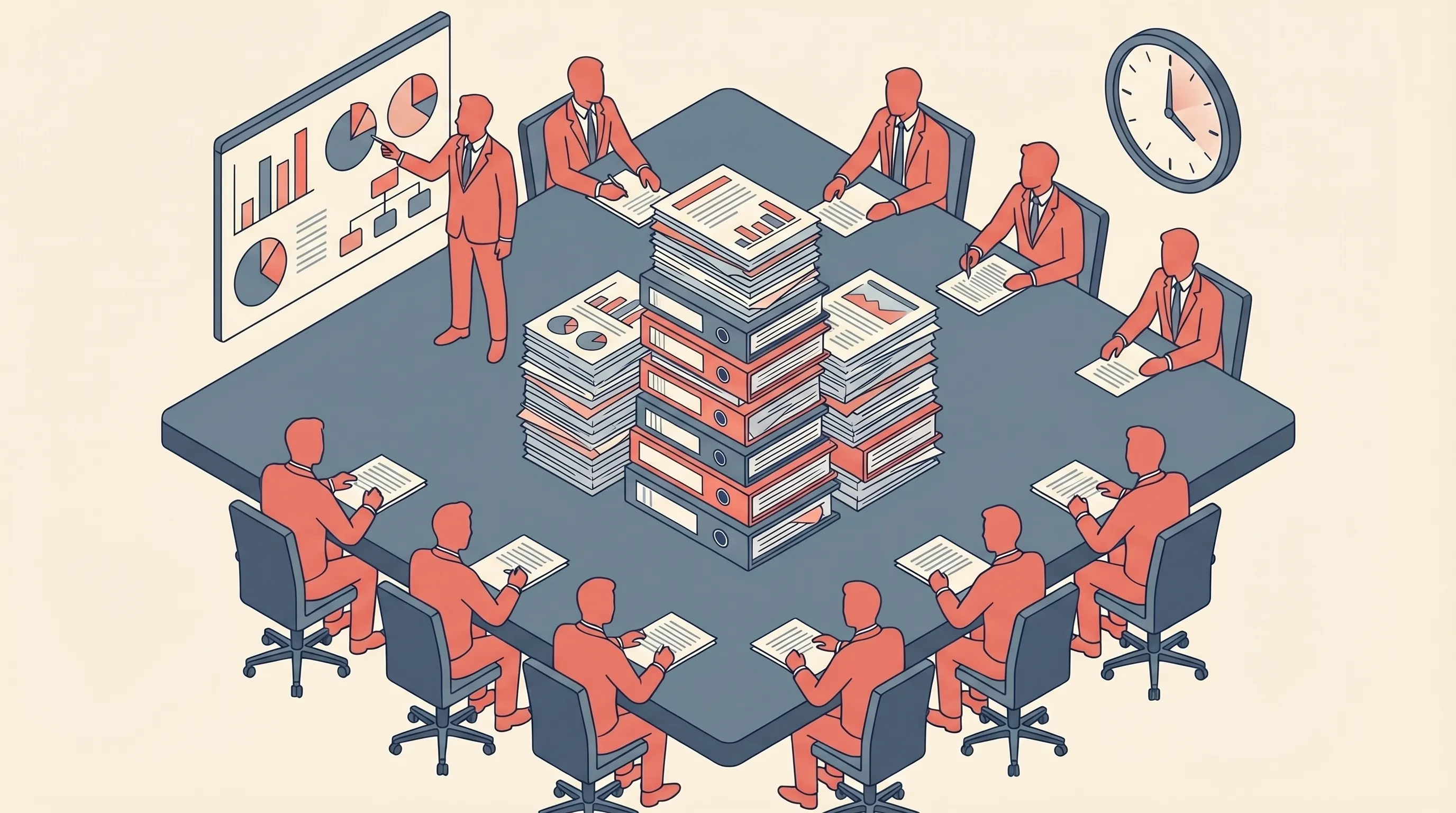
To be fair: as of early 2026, consulting firms are adapting. Accenture has hired over 77,000 AI and data professionals. McKinsey's internal AI platform Lilli is used by 72% of staff. OpenAI just formed a "Frontier Alliance" with McKinsey, BCG, Accenture, and Capgemini. The industry knows it needs to change.
But the structural incentives of the traditional model haven't caught up.
AI projects need deep technical expertise. The traditional model staffs junior analysts.
AI projects need fast iteration. The traditional model delivers quarterly reviews.
AI projects need someone who stays to maintain and improve the system. The traditional model moves to the next engagement.
AI projects need simplicity. The traditional model is incentivized to propose complexity, because complexity means more billable hours.
Even Capgemini's Chief Strategy Officer recently admitted the shift: "At the end, people want the cake, not the recipe." But knowing the old model is under pressure and actually changing how you staff and deliver are two different things.
In one firsthand account that gained significant traction among senior engineers, a developer described watching the old model play out in real time: consultants came in, interviewed staff, presented a doc of problems to a non-technical CEO. The existing tech leadership was fired. The lead consultant was named interim CTO. They brought in 20 to 30 engineering consultants from the same firm. And the interim CTO's first big initiative? "Get our code running on a modern Kubernetes platform," which, as the author noted, everything already ran on.
The fundamentals haven't changed since software agents in the 1990s: siloed data that can't talk to other systems, dirty data that needs cleaning (your CRM doesn't know what your support desk knows), fragmented processes, and lack of alignment on objectives. None of this is revolutionary. It's basic software engineering. But it requires someone who actually understands both the technology and the business context.
What It Looks Like When It Works
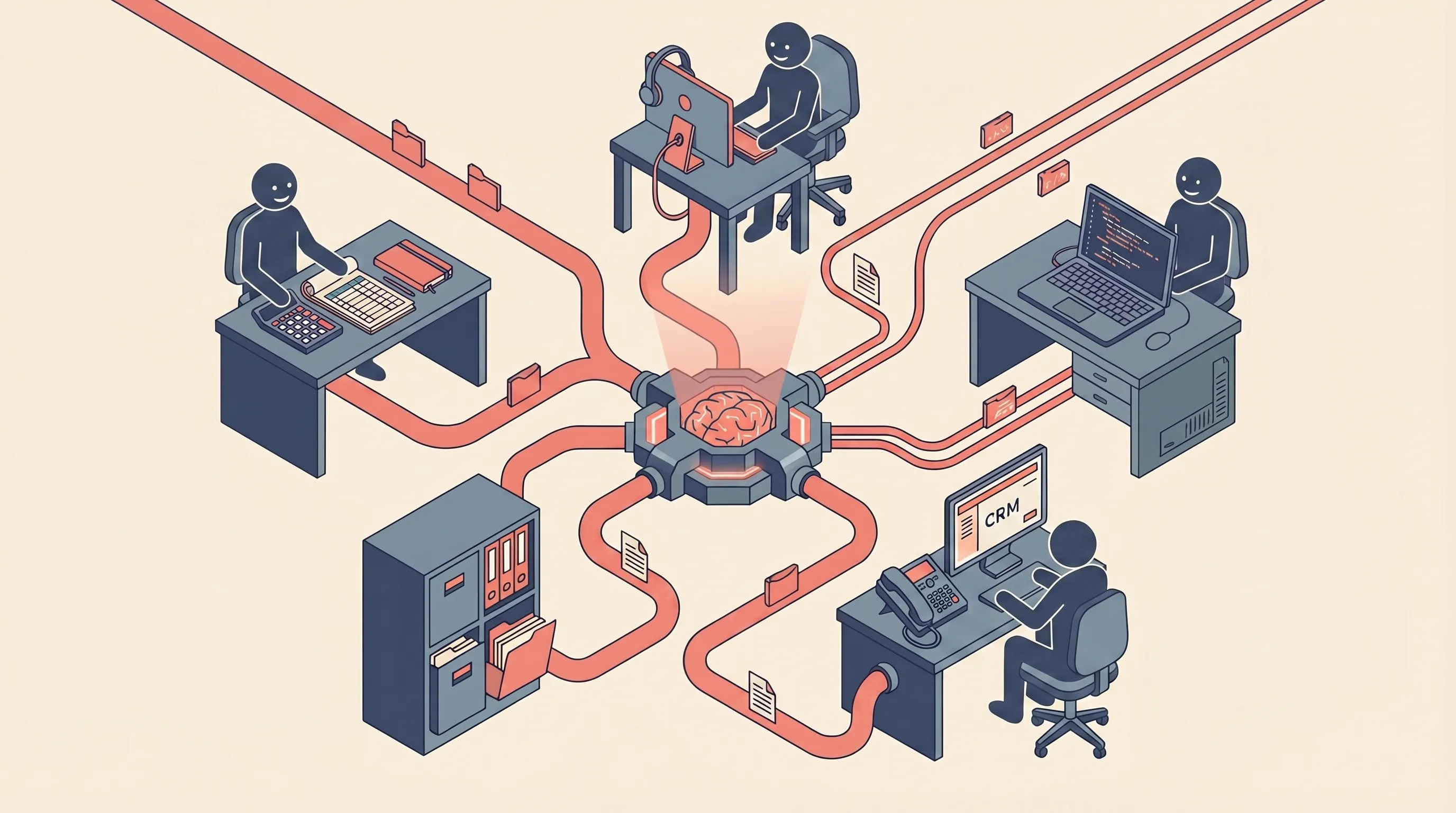
Here's what a well-integrated setup looks like in practice. Your customer support team chats with an AI assistant. A bug comes in. The AI asks follow-up questions, requests a screenshot ("screenshot or it didn't happen"), and creates a proper ticket.
A pipeline automatically looks at the codebase, generates a plan of action, and drops it in your documentation for the developer who'll pick it up.
When sales asks the AI to prep for a client meeting, it already knows there's an active bug in module X and warns them not to demo that feature.
The whole company connected through one system. Support, dev, sales, all aware of each other's context. Not because someone built a custom AI platform, but because one person set up the right integrations.
And this isn't hypothetical. In one firsthand account from an engineering manager, a small team adopted Claude Code, built a shared skills repo, held weekly workflow meetings, and started generating plans and code changes "at the level of an upper mid-level engineer" in one shot. They even had the AI generate skills based on existing runbooks in Confluence, automating manual processes the team had never had time to address. No consultants. No transformation program. Just one motivated technical person and a team that was given the space to figure it out.
As of March 2026, tools like Claude and Codex are mature enough for this kind of work. You don't need a custom-built platform. You need the right integrations, built by someone who understands your specific setup. And unlike a consulting engagement that delivers a strategy deck in month three, this delivers value from week one.
When Internal Teams Outperform Consultants
Companies are figuring this out. Merck, Bristol-Myers Squibb, and CVS Health have all found their internal teams more effective at AI implementation than outside consultants. Their own people understood the business context in ways no external team could.
In one case shared by a practicing data scientist, a single conversation with executives about how AI actually works saved their company $100,000 per year. The company was about to buy an expensive AI-driven analytics tool that did nothing their existing Tableau dashboards couldn't already do. No consultant needed. Just someone with domain knowledge and the ability to translate the technology.
How We Think About This
Quick disclosure: I co-founded BrainBlend AI, and this is the work we do. Our approach is deliberately the opposite of the traditional consulting playbook: come in, assess what's actually broken, set up the critical pieces, train your team, and step back. The goal is to make you the expert, not keep you dependent on us.
I'm the creator of Atomic Agents, an open-source multi-agent framework, so we bring real engineering depth. But integrating AI into a business doesn't require the new paradigms most vendors are selling. The fundamentals are the same as they've always been: clean data, clear processes, unified systems. That's what we help you build. Then we step back.
What You Should Do Instead
If you're a decision-maker who just got pitched a multi-million dollar AI transformation, consider this:
Start small. Pick one department with a clear, measurable pain point. Not "transform our business with AI." More like "reduce ticket resolution time by 30%."
Find your AI champion. Someone internal, or a small external team, with actual technical depth. Someone who builds things, not slide decks. Give them freedom and budget to experiment, and don't track adoption metrics. The companies where AI adoption actually works give teams space to figure it out. The ones that mandate 80% daily AI usage tied to revenue targets end up with engineers prompting nonsense for five minutes to hit quota. Freedom and trust produce results. Mandates produce theater.
Unify your stack. Get everyone on the same ecosystem. One AI platform, with custom integrations per team. Not 50 different tools that don't talk to each other.
Find your biggest skeptic. Get them on board. If they're convinced, everyone else will follow.
Share knowledge internally. People showing each other how they use AI is worth more than any consulting playbook.
Measure everything. If you can't track whether AI is actually helping, you have no way of knowing if it's working.
AI can deliver real value. But the conditions for success are specific: clear objectives, clean data, unified systems, and people who understand both the technology and your business. The question is whether the people you're hiring to help actually know what it takes, or whether they're just really good at selling the idea that they do.
Ready to build AI that works?
Whether you're just getting started or scaling an existing initiative, we can help your team move faster and get real ROI.
Let's talk